


Welcome, my friend.
I’m gonna be pulling back the curtain a bit on this one. If you’re uncomfortable with math or marketing, you might want to give this one a miss or at least have a strong drink ready. No judgment from me.
A month ago, I was fretting myself into a nervous wreck over the UTW launch, finishing the filming just three days before the premiere. I spent the final night before each video went live dotting the last i’s and crossing the last t’s. (Often literally, as adding the subtitles in English and Spanish is my last task before publishing.)
I’m pleased to report that I’m no longer fretting over the UTW launch.
To recap: our first objective as UTW is to ratify the No Confidence Amendment, which will serve as a reset for the United States Federal Government. The initial six articles, from “There’s Gotta Be A Pony Somewhere” to “You Are Not Alone”, describe what No Confidence entails and outline our overarching strategy. I published these six daily from June 29 to July 4.
I’m actually going to go back a bit further than that to start, though.
The Origins of No Confidence
When I initially drafted the No Confidence Amendment, it was more of a joke. Not because it was poorly made—though, in hindsight, it was laughably incomplete—but because I wasn’t genuinely serious about it. It was late 2025, and I was overwhelmed with anger, and I wanted to rip and tear the power away from these terrible leaders with no real understanding of what it truly means to be American.
It was one of a pair; the other amendment I drafted was called No Kings, which provided more punishment to the expelled politicians than No Confidence did and does. The No Kings Amendment was little more than a revenge fantasy, but as I said, I was angry.
It was all just a fantasy, honestly. I had always stayed away from politics. When I mention the “silent majority” in America, that was me a year ago. (That’s why I’m not well-known.)
I couldn’t get No Confidence out of my head, though. I knew it was unlikely that it could ever be ratified, but I follow a personal rule: I’m not allowed to declare a task “impossible” until after I’ve given it at least one good honest try myself.
A Good Honest Try
So I put some effort into it. I cleaned up my rough draft. I emailed my state representative, which was probably the first time I’ve done that in my life. I was quite surprised when he responded immediately to arrange a meeting.
Something I never knew about political meetings: they’re never with just one person. In the corporate world, if two names are on a meeting list, then two people will be in the room (or on the Zoom). However, my meeting with my state legislator also included his aide and a part-time intern taking notes, and that was totally fine.
It’s not like I write UTW as a one-on-one dialogue because I get uncomfortable speaking to crowds or anything like that.
My friend, I expected the part where he told me he couldn’t personally help me with a Constitutional Amendment at that moment. What surprised me was when he added, “…but let me get you some contact details for our district’s Representative in the House.”
I don’t get to claim something is impossible until I’ve given it a good honest try. I scheduled a meeting.
I wasn’t caught off-guard by the additional people in the room this time. And this time, I was paying closer attention. When they said, “We can’t help you,” I couldn’t shake the feeling like what they truly meant was exactly that: “We can’t help you.”
Not “won’t”. Can’t. That part is very similar to a lesson I learned in the corporate world, the rule of the status quo: those with power have little freedom, and those with freedom have little power.
Nothing I saw in those rooms suggested that any of those people wouldn’t jump at a real opportunity to challenge the current status quo. What I saw was that they simply could not risk it in the present political climate, certainly not without having any sort of assurance that it was what America truly wanted.
But there is another way to make a difference in America, isn’t there? It’s rare, but sometimes a grassroots movement hits the perfect tone for the moment, and suddenly it’s all anyone is talking about.
It’s a laughable idea. You can’t plan for popularity any more than you can plan to win the lottery. And if anyone could do it, it wouldn’t be someone like me. It was essentially impossible.
I just wasn’t allowed to call it completely impossible. Unless.
Striking the Right Note
I registered the domain unfuckingtheworld.org on April 6.
The name is an homage to a blog I followed some time ago called Unfuck Your Habitat, or UfYH. Before I discovered UfYH, I never considered cleaning worthwhile unless I had the time and energy to do it properly. After all, if you clean your room but it’s still messy afterward, you can’t really be said to have cleaned it, can you?
It shouldn’t have been such an epiphany to be told, “if your living space is a complete disaster, addressing only the worst bits until it’s only an utter mess is an improvement,” but it really was. The idea of to unfuck has been enshrined for me ever since as, “to tackle the most urgent and severe issues first, creating space to deal with everything else.”
(And when I was a young adult utterly failing to keep my living space under control, it didn’t really seem fitting to use a verb as gentle as “clean” or “tidy” for what felt more like an excavation project.)
Right now, that’s all I really want. I’m no politician. I’m not trying to join the debate over what the very best solutions are. I just want us all to stop yelling at each other long enough to put the fire out before the whole house burns down.
My plan was that I’d put those first six articles out, they’d go relatively unnoticed, and then I could quietly take myself back off the Internet. I could then convince myself that I’d done literally everything possible, after which I could abandon the No Confidence idea and go back to writing my novel.
In order to say that I’d given it an honest try, though, I had to pull out all the stops. I commissioned a gorgeous website which now lives at UTW.vote, since I have very little design sense to speak of. I have little audio and no video experience, so the podcast and video versions of UTW are professionally-done too.
Ultimately, if UTW fails, I don’t ever want to wonder, “but what if I’d also tried…?”
This means I’m also purchasing ads to spread the word. During launch week, I mainly bought text ads on Google and Facebook. Now that UTW is in video form too, I’ve begun creating short teaser videos for every new article, each around a minute long, with no profanity to make them easier to share and suitable for advertising.
I didn’t realize at the time just how useful that would become later.
The Quietest Echo
It’s not an ideal time to be involved in American politics, is it? We’re all feeling afraid, partly because we know that the law no longer offers protection. The modern era also provides other dangers that come with speaking out online on any topic, threatening employment, housing, and other critical necessities.
Part of this is also because so much data is constantly being gathered about us. A comment on YouTube can get harvested for intent and then sold to you as a product on Etsy the very same day. We have all become more cautious about what information we reveal about ourselves online.
I don’t receive many public comments on UTW articles so far, but that doesn’t imply the message isn’t resonating.
Did you know that when you watch a video online, the creator can see which parts you skipped over or replayed? Not you personally, but the audience as a whole. It’s called audience retention, usually shown as a line graph indicating how many viewers are still watching at any given point in the video.
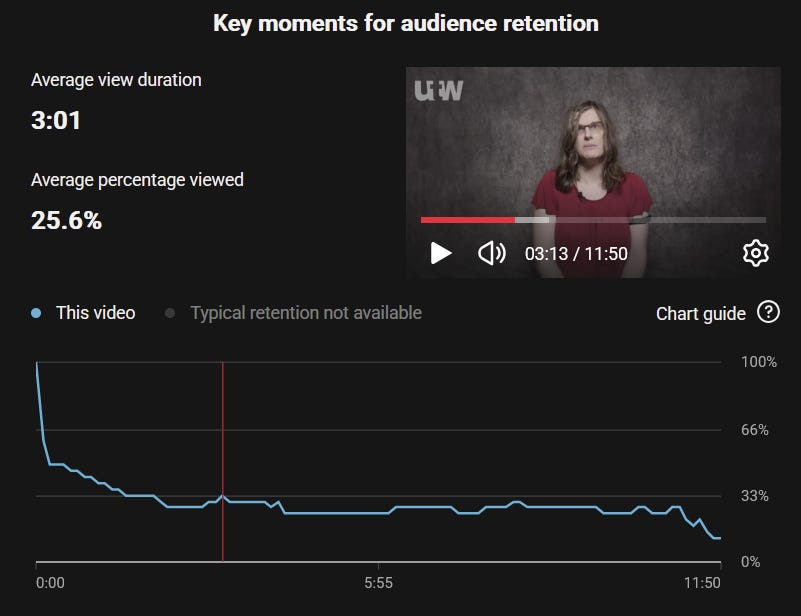
Since this was all quite new to me, I had no basis for comparison when I told my friend how nice it was that about a quarter of my audience watched through to the outro of each video. I assumed 25% was likely on the low side. After all, why bother clicking on a video if you’re not going to watch it through to the end?
My friend informed me that for new channels nobody knows about, the typical retention rate for long-form videos is about 5%.
The retention graph for each UTW video looks similar: a swift decline at the start, as viewers decide whether or not to continue watching, followed by a relatively flat line for the rest of the video. Those who stay for more than a minute or two generally watch until the end. Apparently, in the world of online video, this is Doing Numbers.
It still doesn’t sound impressive though, does it? After all, these are people who clicked on the video—whether by accident or intentionally—and only one in four chose to watch all the way through. Then again, I have certainly ever decided that 10 minutes is just a little more time than I want to spend watching a video essay, even if I enjoy the presenter. There are countless reasons to choose to watch or skip a video.
Then I started getting numbers back on the ads.
The UTW teasers are appearing as preroll ads on YouTube and elsewhere, and the retention rates (called “view-through rates” in the ad industry) are astonishing even to me. Approximately 60% of viewers are watching the full minute-long ad instead of skipping after six seconds.
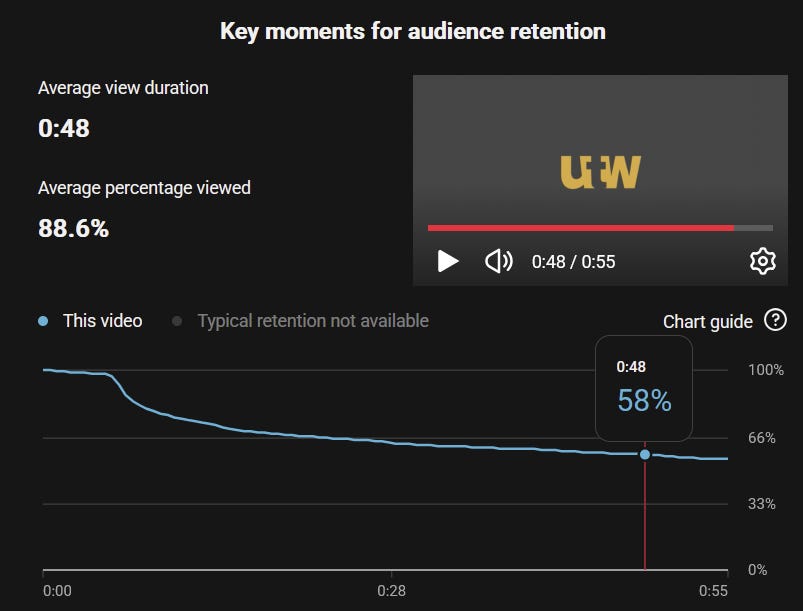
They’re all performing like that; all but one of them, in which I ask the viewer to avoid thinking of other Americans as their enemies. That was apparently quite an unpopular point of view; only four of every ten viewers kept watching through to the end, not six. Bad news for anyone whose religion teaches “love thy enemies”, I suppose.
Growth Curves
I’m not naïve enough to think that a movement can be built solely on advertising. For one thing, I don’t have unlimited funds. I’m just one person. More crucially, though, advertising offers diminishing returns. There’s a limited pool of people I can reach through ads, and the longer they run, the higher the chance that people will have already seen them.
That’s okay. The ads are just a stopgap measure anyway; they’re wildly ineffective compared with personal recommendations. Substack doesn’t have paid ads the way Facebook and YouTube do; that’s one of the reasons I chose it for UTW in the first place.
That has made my subscriber count extremely predictable. When I have the energy for social media, and I post or comment about UTW, it gains more subscribers. On days when I don’t, it generally doesn’t.
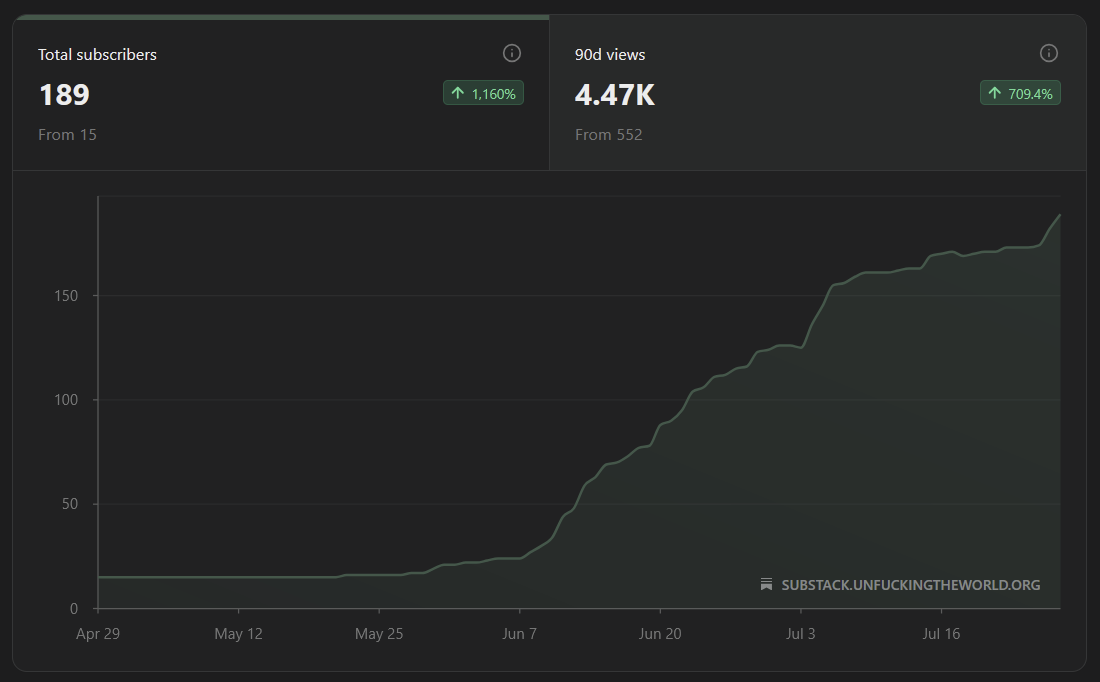
You can practically track the amount of spare energy I had for interaction over the past few months by looking at the Substack subscriber curve. Before the launch, I was promoting UTW every day—through comments, in person, in DMs. Not a single day went by without UTW gaining at least one new subscriber, averaging to about three new subscribers per day.
Once launch week began on June 29, all my energy went to ensuring each article and episode was published on schedule. I had nothing left for promotion, and so UTW stopped attracting new subscribers until the July 4 conclusion. Afterward, I spent a few more days talking up UTW—but with all the content now available, the same effort gained new subscribers at a rate of around ten per day.
(Then I fell over for a few weeks, because I’d been burning the candle at both ends for three months straight.)
That’s what happens when only one person promotes UTW, and that actually hasn’t been the case for a little while now. I get a notification whenever someone links to a UTW article, and the new subscriber notification doesn’t generally take long to follow.
In my own experience and from watching others, it’s really easy to get people excited about UTW in one-on-one interactions. As more people learn about UTW, there will be more people willing to talk about it, both in public and in private. As the number of subscribers goes up, the rate of new subscribers will increase as well, in the social media equivalent of compound interest.
That means that, while it’s likely to keep being overshadowed by my own networking and advertising efforts for a few weeks yet still, UTW’s subscriber count is now beginning to exhibit an exponential growth curve.
So that’s pretty neat.
Next Time
I hope this encourages you to share the message, my friend. Just keep in mind: about 60% of Americans who see me discuss removing our government voluntarily prefer to keep listening to me rather than switch to what they were going to watch, when given the choice. This isn’t limited to just one political party.
I’m going to take a little break from talking about No Confidence next week. You and I both understand how important it is, but being important doesn’t change the fact that it will take time for us to gather the support we need.
For now, my friend: keep fighting, and stay safe.
Thank you for spreading the word! I never expected we’d get even as far as we have, and I’m excited to see how far we’ll go.
Be sure and subscribe and check your notification settings if you want to stay informed about UTW and No Confidence, and I’d really appreciate if you hit the like button so I know I’m on the right track.
UTW is for Americans who love our country enough to argue with it. I welcome your uncertainty, your cynicism, and your skepticism in the comments; all that I ask is your good faith.
Share this with someone you know who thinks this could never work, and stay safe.
–Danielle
Este artículo también esta disponible en español.
[https://youtu.be/oHACWOXU7ww]


